A global dimension to science education in schools: Difference between revisions
From OER in Education
No edit summary |
No edit summary |
||
| (23 intermediate revisions by 4 users not shown) | |||
| Line 1: | Line 1: | ||
{{ResourcePageGroupMenu|OU Teach Learn}} | {{ResourcePageGroupMenu|OU Teach Learn}} | ||
{{Rinfo | {{Rinfo | ||
|type= Teacher Education | |||
|attribution={{OpenLearn}} | |||
|title=A global dimension to science education in schools | |title=A global dimension to science education in schools | ||
|topic=Science | |topic=Global education | ||
|subject= | |image=Globalscience1.png | ||
|resourcenumber= | |tagline=Science and technology beyond the Western world | ||
|age= | |subject=Science, Cross-curricular | ||
|content= | |resourcenumber=TE017 | ||
|strategy= | |age= Primary, Higher, Secondary | ||
|Learning Objectives= | |content= This is a tutorial covering the following topics: | ||
* Why include a global dimension in science education? | |||
* Looking outside the ‘western world’. | |||
* Science throughout history: a case of attribution? | |||
* Teaching global science. | |||
|strategy= | |||
|Learning Objectives= | |||
* Understanding why the global dimension in science is so important. | |||
* Identifying what contributions have been made to science by ‘non-Western’ scientists. | |||
* Learning how to deliver the curriculum and bring global science to life for students. | |||
|additional resources= | |additional resources= | ||
|useful information= | |useful information=From the Open University's Teach and Learn series. | ||
|related resources= | |related resources= | ||
|other= | |other= | ||
|format= | |format=Web tutorial with eleven PDF documents and two mp3 audio files | ||
|resources=http://openlearn.open.ac.uk/course/view.php?id=2478 | |resources=[http://openlearn.open.ac.uk/course/view.php?id=2478 Web tutorial] | ||
|final=yes | |||
}} | }} | ||
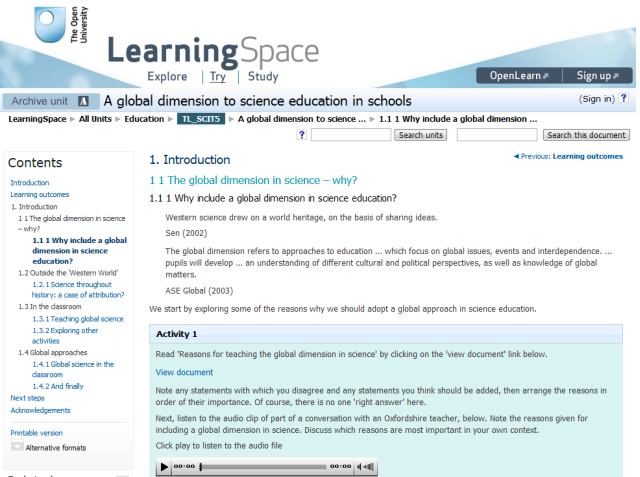
[[Image:Globaldimension.png|700px|link=http://openlearn.open.ac.uk/course/view.php?id=2478]] | |||
[[Category:Secondary]] [[Category:Science]][[Category:Teacher Education]][[Category:External Resource]] | [[Category:Secondary]] [[Category:Science]][[Category:Teacher Education]][[Category:External Resource]][[Category:Global]] [[Category:Cross-curricular]] | ||
Latest revision as of 18:36, 31 January 2015

Science and technology beyond the Western world
About. This is a tutorial covering the following topics:
- Why include a global dimension in science education?
- Looking outside the ‘western world’.
- Science throughout history: a case of attribution?
- Teaching global science.
Pedagogical content. This study unit is aimed at teachers who would like to give a more global feeling to their teaching. It shows how to source articles with an emphasis on science and technology beyond the Western world and how to incorporate them into teaching the curriculum. (edit)
| Resource details | |
| Title | A global dimension to science education in schools |
| Topic | [[Topics/Global education|Global education]] |
| Teaching approach | [[Teaching Approaches/|]] |
| Learning Objectives |
|
| Format / structure | Web tutorial with eleven PDF documents and two mp3 audio files |
| Subject | [[Resources/Science|Science]], [[Resources/Cross-curricular|Cross-curricular]] |
| Age of students / grade | [[Resources/Secondary|Secondary]], [[Resources/Primary|Primary]], [[Resources/Higher|Higher]]
|
| Useful information | From the Open University's Teach and Learn series.
|
| Files and resources to view and download |
|