Inclusive Teaching in Science: Difference between revisions
SimonKnight (talk | contribs) No edit summary |
SimonKnight (talk | contribs) No edit summary |
||
| Line 5: | Line 5: | ||
<hr> | <hr> | ||
=Inclusion in science= | |||
==Gifted and talented pupils== | |||
The yearly learning objectives in the renewed Framework for secondary science are targets for the majority of pupils in a year group. Able pupils deal with abstract science more readily than other pupils. They will progress more quickly through these learning objectives and will need extension and enrichment activities to develop the breadth of their science and the depth of their thinking. | The yearly learning objectives in the renewed Framework for secondary science are targets for the majority of pupils in a year group. Able pupils deal with abstract science more readily than other pupils. They will progress more quickly through these learning objectives and will need extension and enrichment activities to develop the breadth of their science and the depth of their thinking. | ||
| Line 21: | Line 21: | ||
It is also important that gifted and talented pupils are fully representative of the school or college population. This can mean using multiple criteria and sources of evidence and ensuring that there is shared understanding of the meaning of ‘gifted and talented’. | It is also important that gifted and talented pupils are fully representative of the school or college population. This can mean using multiple criteria and sources of evidence and ensuring that there is shared understanding of the meaning of ‘gifted and talented’. | ||
==Supporting English as Additional Language (EAL) learners== | |||
Literacy difficulties can slow some pupils’ progress dramatically in science. These issues can apply to a range of groups in school, including EAL learners, who may need support to develop language and to access the science curriculum. | Literacy difficulties can slow some pupils’ progress dramatically in science. These issues can apply to a range of groups in school, including EAL learners, who may need support to develop language and to access the science curriculum. | ||
| Line 30: | Line 30: | ||
* language acquisition goes hand-in-hand with cognitive and academic development, with an inclusive curriculum as the context. | * language acquisition goes hand-in-hand with cognitive and academic development, with an inclusive curriculum as the context. | ||
==Strategies to support EAL learners in science== | |||
It is all too easy to underestimate what pupils can achieve in science simply because they are new learners of the English language. Expectation should be that they progress in their scientific learning at the same rate as other pupils of their age. | It is all too easy to underestimate what pupils can achieve in science simply because they are new learners of the English language. Expectation should be that they progress in their scientific learning at the same rate as other pupils of their age. | ||
| Line 46: | Line 46: | ||
* helping pupils to talk through their ideas before trying to write about them and scaffolding the writing at a level appropriate to the pupils’ skills in writing in English. | * helping pupils to talk through their ideas before trying to write about them and scaffolding the writing at a level appropriate to the pupils’ skills in writing in English. | ||
==Early-stage learners of English== | |||
Science lessons are a great place for early-stage learners of English to achieve. Science has the advantage of providing an environment in which learning can occur through using visual and auditory clues. Practical and interactive work provides a great opportunity for early-stage bilingual pupils to learn from seeing and doing, and so start to develop confidence in using English. They can listen to other confident users of English talk about what they are doing in practical work and interactive learning situations. | Science lessons are a great place for early-stage learners of English to achieve. Science has the advantage of providing an environment in which learning can occur through using visual and auditory clues. Practical and interactive work provides a great opportunity for early-stage bilingual pupils to learn from seeing and doing, and so start to develop confidence in using English. They can listen to other confident users of English talk about what they are doing in practical work and interactive learning situations. | ||
If the bilingual learner has already been taught science in their first language, then they are likely to know some of the science and start to develop appropriate English to describe the science. If there are other speakers of their first language, they can discuss the science in their first language and then in English, so ensuring that they can learn continue to learn the science and start to develop the English in context. | If the bilingual learner has already been taught science in their first language, then they are likely to know some of the science and start to develop appropriate English to describe the science. If there are other speakers of their first language, they can discuss the science in their first language and then in English, so ensuring that they can learn continue to learn the science and start to develop the English in context. | ||
==More advanced learners of English== | |||
When a bilingual pupil starts to learn English, they can take up to five years to become fully fluent in all aspects of the language. Initially they will gain confidence in speaking English. This is soon followed by gaining confidence and expertise in aspects of reading. Much later they start to gain skills in writing. Unless EAL pupils are well supported in their reading and writing in science, they often underachieve, particularly in summative assessments and examinations. | When a bilingual pupil starts to learn English, they can take up to five years to become fully fluent in all aspects of the language. Initially they will gain confidence in speaking English. This is soon followed by gaining confidence and expertise in aspects of reading. Much later they start to gain skills in writing. Unless EAL pupils are well supported in their reading and writing in science, they often underachieve, particularly in summative assessments and examinations. | ||
| Line 62: | Line 62: | ||
Once EAL pupils have developed the basics of reading English, they still need considerable support to write English using the genres required in science. Just as the types of reading in science are subject-specific, so is the writing. Science teachers need strategies that develop reading and writing skills through science lessons. Teachers can access support from other specialist colleagues in school such as EAL teachers and use literacy in science materials in order to help more advanced bilingual learners to make good progress in science. | Once EAL pupils have developed the basics of reading English, they still need considerable support to write English using the genres required in science. Just as the types of reading in science are subject-specific, so is the writing. Science teachers need strategies that develop reading and writing skills through science lessons. Teachers can access support from other specialist colleagues in school such as EAL teachers and use literacy in science materials in order to help more advanced bilingual learners to make good progress in science. | ||
==Pupils with special educational needs (SEN), learning difficulties and disabilities (LDD)== | |||
Approximately 20% of the school population is defined as having SEN and/or LDD. Some of these pupils will also have learning difficulties linked to social deprivation, and some with special educational needs will also have disabilities. The learning difficulties encountered are often, but not always, in association with literacy and numeracy development, and are sometimes aggravated by missed or interrupted schooling, perhaps due to long-term medical conditions. | Approximately 20% of the school population is defined as having SEN and/or LDD. Some of these pupils will also have learning difficulties linked to social deprivation, and some with special educational needs will also have disabilities. The learning difficulties encountered are often, but not always, in association with literacy and numeracy development, and are sometimes aggravated by missed or interrupted schooling, perhaps due to long-term medical conditions. | ||
| Line 77: | Line 77: | ||
* sensory or physical difficulties. | * sensory or physical difficulties. | ||
==Communication and interaction== | |||
Pupils who have difficulty in communicating or interacting face particular challenges in science. They need clear, effective teaching that steadily builds their confidence and participation. Use a structured approach to develop the scientific language you expect them to use. Some pupils with speech and language impairments have no other developmental difficulties, and science lessons provide the opportunity to work alongside peers, practising and discovering strategies to overcome their difficulties. However, pupils who have autistic spectrum disorders require well-structured lessons with clear routines and predictable parts. They respond best when the language used is concise, teaching is explicit, and challenges are direct and well focused. Your expectations for what these pupils will learn and do, both in the lesson overall and in each separate part or activity, need to be defined very clearly. | Pupils who have difficulty in communicating or interacting face particular challenges in science. They need clear, effective teaching that steadily builds their confidence and participation. Use a structured approach to develop the scientific language you expect them to use. Some pupils with speech and language impairments have no other developmental difficulties, and science lessons provide the opportunity to work alongside peers, practising and discovering strategies to overcome their difficulties. However, pupils who have autistic spectrum disorders require well-structured lessons with clear routines and predictable parts. They respond best when the language used is concise, teaching is explicit, and challenges are direct and well focused. Your expectations for what these pupils will learn and do, both in the lesson overall and in each separate part or activity, need to be defined very clearly. | ||
==Cognition and learning== | |||
The attainment of pupils with significant cognition and learning difficulties is likely to be well below age-related expectations. For them, a much greater degree of differentiation will be necessary. You may need to refer to younger pupils’ Schemes of Work, situating them in a context suited to older pupils. Extra ‘small steps’ can be inserted, and contexts for practical work and problem solving adapted. There will then be time for consolidation without sacrificing the breadth of the teaching programmes or the principle of planning from clearly defined objectives. | The attainment of pupils with significant cognition and learning difficulties is likely to be well below age-related expectations. For them, a much greater degree of differentiation will be necessary. You may need to refer to younger pupils’ Schemes of Work, situating them in a context suited to older pupils. Extra ‘small steps’ can be inserted, and contexts for practical work and problem solving adapted. There will then be time for consolidation without sacrificing the breadth of the teaching programmes or the principle of planning from clearly defined objectives. | ||
==Behaviour, emotional and social development== | |||
Many pupils with emotional and behavioural difficulties have poor literacy and numeracy skills as a result of their inability to maintain concentration and persevere with tasks. They can be supported by | Many pupils with emotional and behavioural difficulties have poor literacy and numeracy skills as a result of their inability to maintain concentration and persevere with tasks. They can be supported by | ||
| Line 95: | Line 95: | ||
All pupils have an entitlement to the opportunity to develop emotional and social literacy, but pupils with emotional and behavioural difficulties have an urgent need in this area. | All pupils have an entitlement to the opportunity to develop emotional and social literacy, but pupils with emotional and behavioural difficulties have an urgent need in this area. | ||
==Sensory or physical difficulties== | |||
Often pupils with sensory or physical difficulties are intellectually able but may need to develop proficiency with particular aids. These pupils will work on the same science programme as their peer group. Expectations for them should remain high, with the focus on giving them maximum access and independence. | Often pupils with sensory or physical difficulties are intellectually able but may need to develop proficiency with particular aids. These pupils will work on the same science programme as their peer group. Expectations for them should remain high, with the focus on giving them maximum access and independence. | ||
Revision as of 10:22, 30 August 2012
This resource is licenced under an Open Government Licence (OGL).
This resource is adapted from the 2008 National Strategies: Secondary 'Framework for secondary Science'. The resource is available in 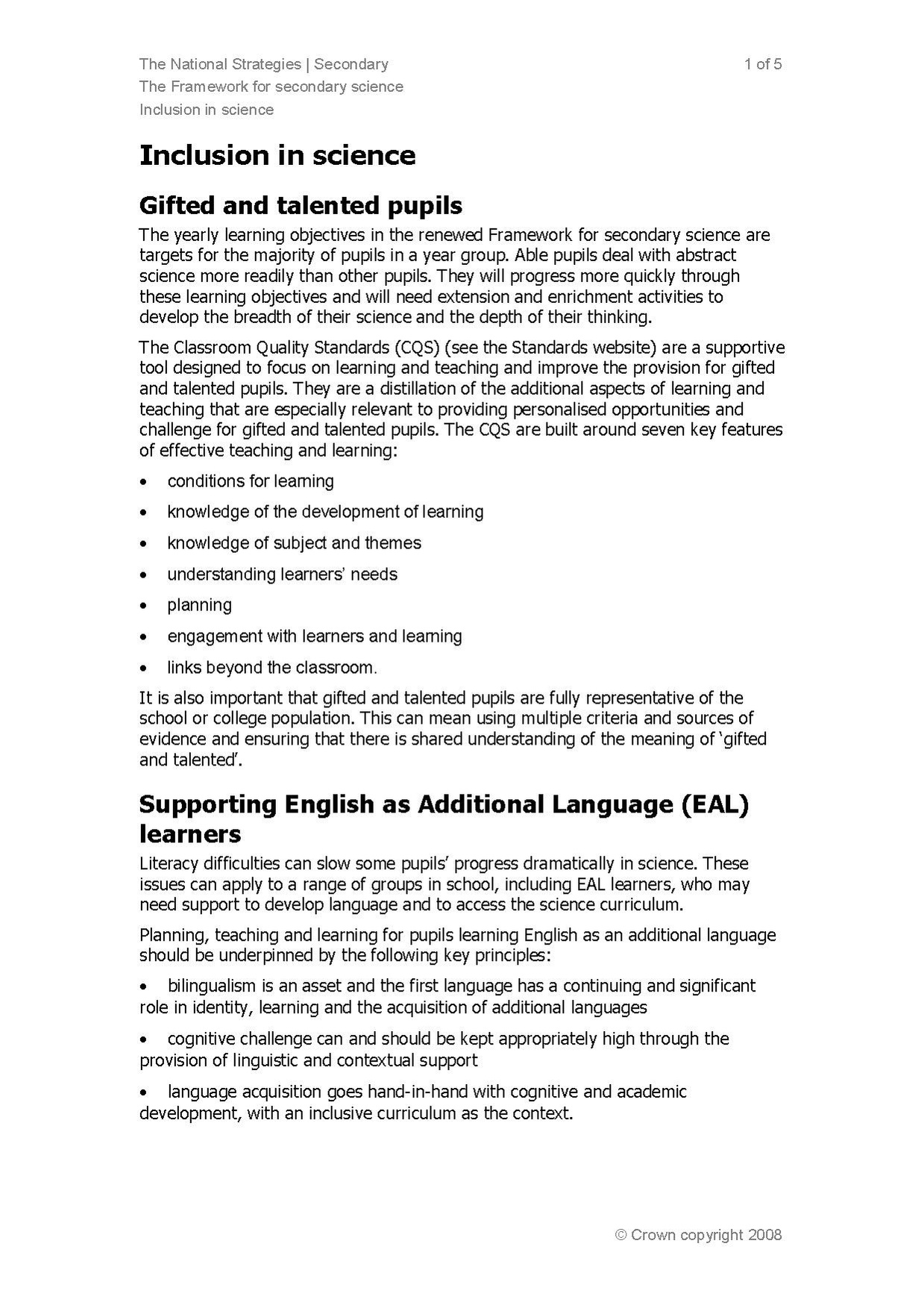 format, and editable (File:Inclusive Teaching in Science.doc) format. It can also be downloaded from the National Archives here.
Inclusion in science
Gifted and talented pupils
The yearly learning objectives in the renewed Framework for secondary science are targets for the majority of pupils in a year group. Able pupils deal with abstract science more readily than other pupils. They will progress more quickly through these learning objectives and will need extension and enrichment activities to develop the breadth of their science and the depth of their thinking.
Previous Government guidance identified seven key features of effective teaching and learning
- conditions for learning
- knowledge of the development of learning
- knowledge of subject and themes
- understanding learners’ needs
- planning
- engagement with learners and learning
- links beyond the classroom.
It is also important that gifted and talented pupils are fully representative of the school or college population. This can mean using multiple criteria and sources of evidence and ensuring that there is shared understanding of the meaning of ‘gifted and talented’.
Supporting English as Additional Language (EAL) learners
Literacy difficulties can slow some pupils’ progress dramatically in science. These issues can apply to a range of groups in school, including EAL learners, who may need support to develop language and to access the science curriculum.
Planning, teaching and learning for pupils learning English as an additional language should be underpinned by the following key principles
- bilingualism is an asset and the first language has a continuing and significant role in identity, learning and the acquisition of additional languages
- cognitive challenge can and should be kept appropriately high through the provision of linguistic and contextual support
- language acquisition goes hand-in-hand with cognitive and academic development, with an inclusive curriculum as the context.
Strategies to support EAL learners in science
It is all too easy to underestimate what pupils can achieve in science simply because they are new learners of the English language. Expectation should be that they progress in their scientific learning at the same rate as other pupils of their age.
Strategies to support learners new to English in science include
- using structured group work to allow intensive, focused teaching input and collaborative work with more expert speakers of English as well as pupils who share a first language
- using structured group work to enable less-confident speakers of English to practise scientific terminology and language in a non-threatening environment so that they can gain confidence in using scientific English appropriately
- using peer-group talk to give pupils time to watch and listen to those fluent in English, and to help them make sense of and apply scientific ideas
- using direct, specific instructions and speaking more slowly, emphasising key words, particularly when describing independent tasks; going through things twice so that pupils get the opportunity to listen and say in their own words what you are asking them to do
- asking individual pupils at the early stages of learning English to present their work orally with support from their peers and only when they are ready
- as soon as English-language beginners are reasonably confident at saying something together with others, asking them to say it again on their own, giving them plenty of time and checking their understanding regularly
- using extra visual clues or gestures, or translation in oral work, and using additional picture cues in written materials
- supporting reading with interactive activities and scaffolds so pupils can access the science learning and ideas
- helping pupils to distinguish words that have different meanings in scientific and everyday contexts
- helping pupils to talk through their ideas before trying to write about them and scaffolding the writing at a level appropriate to the pupils’ skills in writing in English.
Early-stage learners of English
Science lessons are a great place for early-stage learners of English to achieve. Science has the advantage of providing an environment in which learning can occur through using visual and auditory clues. Practical and interactive work provides a great opportunity for early-stage bilingual pupils to learn from seeing and doing, and so start to develop confidence in using English. They can listen to other confident users of English talk about what they are doing in practical work and interactive learning situations.
If the bilingual learner has already been taught science in their first language, then they are likely to know some of the science and start to develop appropriate English to describe the science. If there are other speakers of their first language, they can discuss the science in their first language and then in English, so ensuring that they can learn continue to learn the science and start to develop the English in context.
More advanced learners of English
When a bilingual pupil starts to learn English, they can take up to five years to become fully fluent in all aspects of the language. Initially they will gain confidence in speaking English. This is soon followed by gaining confidence and expertise in aspects of reading. Much later they start to gain skills in writing. Unless EAL pupils are well supported in their reading and writing in science, they often underachieve, particularly in summative assessments and examinations.
In science lessons, pupils need to read and gain meaning from particular types of texts. These texts often include describing
- procedures or experimental investigation
- the form and functions of parts of a system
- processes or mechanisms, such as how a body system or a pulley works. This type of reading requires different skills from reading a novel or newspaper
- article, skills which might be developed in English lessons. Science teachers therefore need to develop the skills of supporting these different types of reading in science for all pupils, but particularly for bilingual pupils.
Once EAL pupils have developed the basics of reading English, they still need considerable support to write English using the genres required in science. Just as the types of reading in science are subject-specific, so is the writing. Science teachers need strategies that develop reading and writing skills through science lessons. Teachers can access support from other specialist colleagues in school such as EAL teachers and use literacy in science materials in order to help more advanced bilingual learners to make good progress in science.
Pupils with special educational needs (SEN), learning difficulties and disabilities (LDD)
Approximately 20% of the school population is defined as having SEN and/or LDD. Some of these pupils will also have learning difficulties linked to social deprivation, and some with special educational needs will also have disabilities. The learning difficulties encountered are often, but not always, in association with literacy and numeracy development, and are sometimes aggravated by missed or interrupted schooling, perhaps due to long-term medical conditions.
In many cases, pupils’ needs will be met through differentiation of tasks and materials. A smaller number of pupils may need access to specialist equipment and approaches, or to alternative or adapted activities. For example, there may be pupils in a class who need support in order to take part in whole-class work, such as
- specific help with the recall of scientific facts, to compensate for difficulties with long- or short-term memory
- help with the interpretation of data represented in graphs, tables or charts, to compensate for difficulties with visual discrimination
- access to tactile and other specialist equipment for making observations and measurements during a scientific enquiry, to overcome difficulties in managing visual information
- help in interpreting or responding to oral directions, to compensate for difficulties in hearing or with auditory discrimination.
It is not possible here to give detailed guidance covering every type of special educational need. However, there are four main areas to consider
- communication and interaction
- cognition and learning
- behaviour, emotional and social development
- sensory or physical difficulties.
Communication and interaction
Pupils who have difficulty in communicating or interacting face particular challenges in science. They need clear, effective teaching that steadily builds their confidence and participation. Use a structured approach to develop the scientific language you expect them to use. Some pupils with speech and language impairments have no other developmental difficulties, and science lessons provide the opportunity to work alongside peers, practising and discovering strategies to overcome their difficulties. However, pupils who have autistic spectrum disorders require well-structured lessons with clear routines and predictable parts. They respond best when the language used is concise, teaching is explicit, and challenges are direct and well focused. Your expectations for what these pupils will learn and do, both in the lesson overall and in each separate part or activity, need to be defined very clearly.
Cognition and learning
The attainment of pupils with significant cognition and learning difficulties is likely to be well below age-related expectations. For them, a much greater degree of differentiation will be necessary. You may need to refer to younger pupils’ Schemes of Work, situating them in a context suited to older pupils. Extra ‘small steps’ can be inserted, and contexts for practical work and problem solving adapted. There will then be time for consolidation without sacrificing the breadth of the teaching programmes or the principle of planning from clearly defined objectives.
Behaviour, emotional and social development
Many pupils with emotional and behavioural difficulties have poor literacy and numeracy skills as a result of their inability to maintain concentration and persevere with tasks. They can be supported by
- ensuring that expectations are high to prevent them becoming bored, for example, not oversimplifying tasks
- structuring lessons to maintain pace, giving opportunities for independent working and using a variety of activities
- using additional adults to help pupils begin tasks and to help them maintain concentration
- using praise to reward good learning behaviours, for example, working effectively in groups
- making science relevant by relating it to the real world.
All pupils have an entitlement to the opportunity to develop emotional and social literacy, but pupils with emotional and behavioural difficulties have an urgent need in this area.
Sensory or physical difficulties
Often pupils with sensory or physical difficulties are intellectually able but may need to develop proficiency with particular aids. These pupils will work on the same science programme as their peer group. Expectations for them should remain high, with the focus on giving them maximum access and independence.
Support should enable them to take part safely and as fully as possible in experimental work. Modifications to science materials, equipment and furniture, and the use of specialist science items, will also help to meet their needs.
Where pupils with sensory impairments need signing support, Braille or materials written in signs or symbols, it is likely that provision will be through a Statement of special educational needs. Where necessary, text should be adapted to a larger print size, or translated into Braille or symbols. ICT should be used to help those with visual impairments to gain better access and understanding.
Pupils with hearing impairments will need to be appropriately positioned in a class and should be helped to gain as much access as possible to science activities by using oscilloscopes and sound level meters, the use of visual demonstrations and using the sense of touch to feel vibrations.
Pupils with visual impairments may need extra time to manage visual information, for example, using microscopes or making observations in experimental work. Extra support may be needed in lessons about light; pupils should be encouraged to use their knowledge that many light sources produce heat.


