OER4Schools/Concept mapping: Difference between revisions
m (Edits for units 1 - 4, revising ICT activities, adding activity tags and timings.) |
m (Edits for units 1 - 4, revising ICT activities, adding activity tags and timings.) |
||
| Line 17: | Line 17: | ||
{{ OER4SchoolsWSInfo/ICT intro students}} | {{ OER4SchoolsWSInfo/ICT intro students}} | ||
* you will continue with Geogebra, images, and typing. | * you will continue with Geogebra, images, and typing. | ||
|resources=If available, large pieces of paper to draw concept maps. | |||
}} | }} | ||
| Line 29: | Line 31: | ||
Display the concept map of water (TESSA resource) ([[File:Concept map of water (TESSA).pdf]]) on the projector. | Display the concept map of water (TESSA resource) ([[File:Concept map of water (TESSA).pdf]]) on the projector. | ||
Note that you can do this session in the following ways: | |||
* If the participants are quite confident in their use of ICT, then you could use concept maps on the netbooks. | |||
* However, if the participants are not that fluent yet in their use of ICT, it is better to just focus on the idea of a concept map (on paper), and to introduce concept mapping software in the ICT practice session for those who would like to explore this. | |||
}} | }} | ||
| Line 49: | Line 54: | ||
}} | }} | ||
{{activity|Pair work| on concept maps| | {{activity|Pair work| on developing ideas for concept maps.|5}} See an example of a concept map on the screen. Tell the person next to you a topic from the curriculum that can be concept-mapped; mention advantages of mapping this topic and how mapping this topic can promote interactive teaching. Don’t actually create a map, just think of a topic and at what stage of teaching it the mapping might be useful. | ||
Decide whether you would start with a few given sub-topics or ask pupils to suggest these – this is optional, depending on the subject material. (All the further ideas on branches from sub-topics come from pupils.) | Decide whether you would start with a few given sub-topics or ask pupils to suggest these – this is optional, depending on the subject material. (All the further ideas on branches from sub-topics come from pupils.) | ||
| Line 55: | Line 60: | ||
{{Ednote|text= | {{Ednote|text= | ||
Set a time limit for the pair work, say 5 minutes, and follow it strictly. | |||
Set a time limit for the pair work, say | |||
Display the blank concept map ‘Learning concept maps’ ([[File:Learning Concept Maps.mm]]) on the screen after 4 minutes. Also open the file on the individual computers – one machine per person. | Display the blank concept map ‘Learning concept maps’ ([[File:Learning Concept Maps.mm]]) on the screen after 4 minutes. Also open the file on the individual computers – one machine per person. | ||
}} | }} | ||
{{activity|Whole group brainstorm| on filling out a concept map.|5}} Brainstorm to help fill up the concept map displayed. | |||
{{activity| | {{activity|Individual activity|: creating your own concept map.|5}} Enter the suggestions as they are made, on the version on your machine. Add any further ideas of your own. | ||
= Discussion = | |||
The main concept that you are mapping is: ''Learning concept maps.'' Suggest any ideas that you can think of related to the topics given below, or suggest new topics. | The main concept that you are mapping is: ''Learning concept maps.'' Suggest any ideas that you can think of related to the topics given below, or suggest new topics. | ||
* Topics that can be explored through concept mapping? | * Topics that can be explored through concept mapping? | ||
* Advantages of concept mapping during teaching? | * Advantages of concept mapping during teaching? | ||
* Ways of using concept mapping to make teaching interactive (with or without using ICT)? | * Ways of using concept mapping to make teaching interactive (with or without using ICT)? | ||
Revision as of 20:18, 8 December 2012

The OER4Schools Professional Learning Resource
Learning intentions and objectives.
In this session you will learn about:
- Learning about concept mapping as a technique to promote interactive teaching
- Encouraging talk that involves reasoning and building on others’ ideas
Success criteria.
To meet the learning intentions you will:
- you have used a concept map in the classroom
ICT components.
The ICT components you will focus on are
- Consolidate your skills with Geogebra, images, and typing.
- Learn about using OO Impress (e.g. adding titles to images)
- (optional) Concept mapping software.
Classroom based activities (with your students, after this session):
- you will continue with Geogebra, images, and typing.
Resources needed.
If available, large pieces of paper to draw concept maps.
Review of follow-up activities from last session
If you are running a professional learning programme which follows these sessions in sequence, then you should do the review of follow-up activities relating to the (Category:OER4S CPD). The 'review of follow-up activities' for that session is available, and also shown below in the session text. However, if you are following selected sessions in a different order, then you should use the reflection appropriate to the previous session you did.
The review of the follow-up activities for this session (to be done at the start of the next session) is available here.
There is no review of follow-up activities from last session available. You can go to the previous session () and.
Introduction to concept mapping
You will need a projector linked to your computer for this session.
Display the concept map of water (TESSA resource) (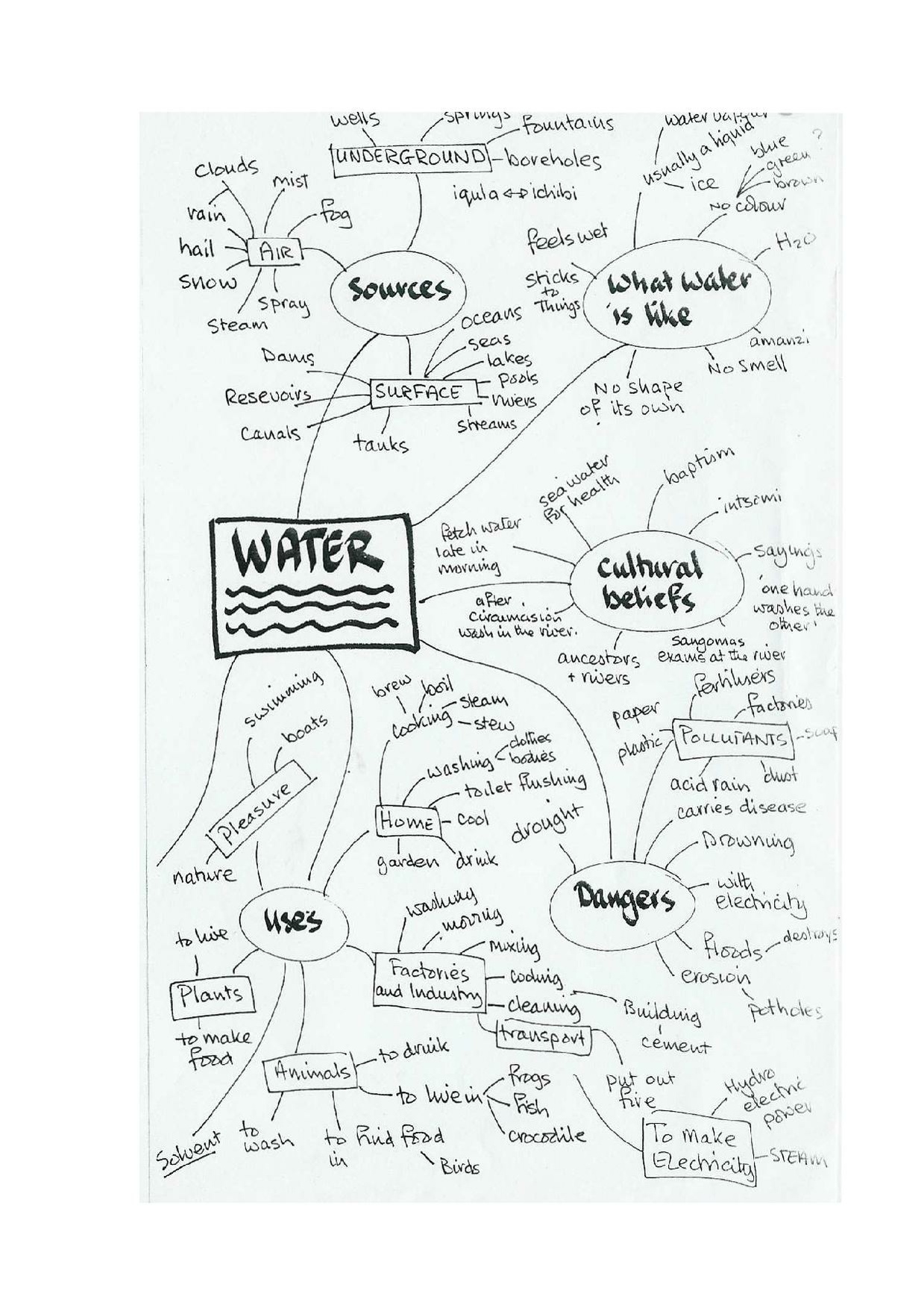 ) on the projector.
Note that you can do this session in the following ways:
- If the participants are quite confident in their use of ICT, then you could use concept maps on the netbooks.
- However, if the participants are not that fluent yet in their use of ICT, it is better to just focus on the idea of a concept map (on paper), and to introduce concept mapping software in the ICT practice session for those who would like to explore this.

A concept map is a visual way of representing pupils’ ideas around a main topic.
Some examples of what concept maps might show are:
- relationships - different types of vegetation and climate
- tasks – designing an electric circuit
- hierarchies - food pyramid
- causes of events - effects of human activities on forests
- flow of processes - water cycle
How is concept mapping used in the classroom?
- A teacher might solicit ideas from the class and draw a single class concept map on the board or on a computer using special concept mapping software, and project it for the class.
- Pupils draw their own personal maps on paper or on a computer; they work individually or in a pair or group.
 Pair work (5 min) on developing ideas for concept maps. See an example of a concept map on the screen. Tell the person next to you a topic from the curriculum that can be concept-mapped; mention advantages of mapping this topic and how mapping this topic can promote interactive teaching. Don’t actually create a map, just think of a topic and at what stage of teaching it the mapping might be useful.
Decide whether you would start with a few given sub-topics or ask pupils to suggest these – this is optional, depending on the subject material. (All the further ideas on branches from sub-topics come from pupils.)
Set a time limit for the pair work, say 5 minutes, and follow it strictly.
Display the blank concept map ‘Learning concept maps’ (File:Learning Concept Maps.mm) on the screen after 4 minutes. Also open the file on the individual computers – one machine per person.
Whole group brainstorm (5 min) on filling out a concept map. Brainstorm to help fill up the concept map displayed.
Individual activity (5 min): creating your own concept map. Enter the suggestions as they are made, on the version on your machine. Add any further ideas of your own.
Discussion
The main concept that you are mapping is: Learning concept maps. Suggest any ideas that you can think of related to the topics given below, or suggest new topics.
- Topics that can be explored through concept mapping?
- Advantages of concept mapping during teaching?
- Ways of using concept mapping to make teaching interactive (with or without using ICT)?
While using concept mapping in an interactive classroom it is important that participants:
- Support their ideas with reasons
- Add to existing ideas if they agree (as in cumulative talk)
- Question/challenge new ideas if they disagree
Use the document File:Learning Concept Maps.mm for reference to fill up this concept map.
During the brainstorm:
- Respect all ideas
- Note only keywords rather than complete sentences (as shown in the ‘water’ example)
- Be as quick as possible in typing the idea so that the activity is swift and ideas are not lost. You can choose between the two options depending on your comfort with typing: typing responses to all questions simultaneously OR considering responses one question at a time. Suggest that the participants make a note of their ideas as they come.
- Stop the brainstorm activity after 20 minutes. Exceeding the time limit can tire the participants.
Save the filled concept map. It will be used later.
Activity: Presenting the concept map
Use sheets of paper (at least A4 size) and coloured pens for this activity. This will help to save the concept maps for future reference. If paper is not available, use mini-blackboards.
Individual or small group activity (11 min). Choose a topic from the topics listed on the map you have created together, i.e. from the box ‘topics that can be explored through concept mapping’ or ‘examples’ given above. It can be a topic you will use in your classroom soon. Draw a concept map on your sheet of paper.
As you draw the concept map, think about different ways in which this concept mapping activity can be used in the classroom? TIP: Think of its uses at the beginning, middle and end of a lesson. Your ideas will be discussed during Activity the activity on progress in concept mapping.
If two or three participants choose the same topic or teach the same subject, suggest that they can work as a group.
You should move around to provide support/ ideas to participants while they are drawing their maps. Give suggestions such as “How about including...” or “Do you think... can also be included?”.
Question the participants - how can you use this concept mapping activity in the classroom?
If some participants finish sooner than the others ask them to read the Teaching and Learning section on pages 34 - 35 plus page 40 of the VVOB toolkit ( ).
).
At the end of the activity, 2-3 participants present their concept map for the whole group. You are role playing as pupils at this time.
During the presentation all participants are actively involved:
- The presenters should explain reasons for their ideas.
- Other participants should build on presenter ideas through agreement comments. For example, ‘ I think it’s a good idea that you included... because...’ or ‘Another idea related to... is...’.
- Other participants can also question/challenge presenter’s ideas through disagreement comments. For example, ‘I think... could be moved under the sub topic... because...’ or ‘How about including...?’ or ‘Why is it important to include...?’
Remember that agreement comments should come before disagreement comments. The idea is to improve the concept map yet not discourage the presenter.
Use one of the ‘increasing participation’ strategies discussed in the previous session for selecting the presenters. You should choose volunteers or participants with good examples of concept maps. Therefore, use the strategy ‘selecting volunteers’, ‘mini-blackboard display’ or ‘teacher nominations’. Inform the participants about your selection strategy in advance.
Model agreement comments and disagreement comments.
Refrain from interjecting if two participants are talking about the concept map. This will demonstrate one way of encouraging pupil-pupil talk.
Distribute VVOB toolkit pages 34, 35 and 40 to participants who have not yet collected it. (See .)
Activity: Progress on concept mapping

Add new ideas that you have learned about concept mapping to the concept map drawn on the computer in the first Activity. Refer to the VVOB toolkit pages for more ideas. Your own ideas about the other ways of using concept maps in an interactive classroom are very valuable.
Activity: Video watching
Property "Todoinfo" (as page type) with input value "Two clips need to be inserted! </br>* LB Lesson 3 can we understand clip.m4v </br>* 11 Brian_4_renewables 11_10_2011 Clip 1.m4v</br>" contains invalid characters or is incomplete and therefore can cause unexpected results during a query or annotation process.
Video 1
In this video, Lloyd, a UK secondary school teacher is facilitating a whole class dialogue during a secondary school history lesson (the all boys class are 12-13 years old). Pupils are discussing if it is possible to imagine living in trenches during the war from historical evidence, which they have discussed earlier in pairs.
See the transcript of this clip below – it may be useful to look at this during the video as the pupils’ voices are sometimes quiet.
Questions for reflection:
- What did you notice about pupil talk in these clips? Is it different from general pupil talk in classrooms? Explain your answer with reasons.
- How does the teacher encourage pupils to make contributions? Give examples from your observations.
Tell the participants that the video illustrates pupils (a) giving reasons for their ideas, and (b) building on previous speaker’s ideas. Also (c) it shows how the teacher has heard Robert’s ideas during pair activity and deliberately invites his ideas into the whole class discussion. Mention these points as your observations if the participants do not notice them.
Participants may refer to transcript during or after the video if they want.
Video 2
This 3.5 mins. video illustrates a Grade 7 Zambian teacher Brian facilitating a whole class dialogue on renewable sources. (The background noise is a heavy rainstorm!)
Questions for reflection are:
- Notice that the teacher asked the pupils to explain their reasoning in selecting renewable and non-renewable materials. How successful was he in doing this?
- What did you think about the horseshoe seating arrangement for this activity? Would this be feasible or effective in your classroom?
Question on both videos:
- Which learning objectives other than the teaching topic are achieved in these video clips?
- What would you do in your classroom to facilitate pupils building on each other’s responses? Are there any phrases that Lloyd used in the first video clip that could support this?
- How can you get children to justify and provide reasons for their responses?
- What would you not do in your classroom if you want to facilitate whole class dialogue?
ICT practice
ICT practice (20 min) on various topics.
- Concept mapping software.
Connecting with overarching goals of the programme
Open space (10 min). It's now time for the "open space", that gives you an opportunity to discuss issues that have arisen, and to relate those to the broader context of the programme. Do not just gloss over this section, but make time to raise issues, and probe the progress that you are making. You could use this space to:
- Remind yourselves of the of the Most Significant Change Technique, and e.g. collect more of your stories.
- Discuss your assessment portfolios: Is there anything that you are unsure about? Is it going well? What could be done better?
- Check on the work with the classroom assistants: Is this going well? Are there any tensions? Any observations or tips you can share?
- Reviewing individual ICT practise (such as typing practise).
- If you are preparing a presentation for other teachers, you could work on the presentation (about what you have been learning, stories emerging from MSC).
- Remind those who are doing audio diaries, to upload them.
- You could discuss any other issues that have arisen.
You will find notes and summaries of various techniques and concepts on our reference page, and you might want to refer to those for clarification during this activity if needed.
Follow-up activities for you to try in class
Agreeing follow-up activities (5 min).
Try concept maps
Choose a topic that you can teach in your class using concept maps; it could be the one you tried out earlier on paper. Think of some sub-topics for which you will ask your pupils to brainstorm.
Draw this concept map using freemind software on the netbooks. Create a template concept map that you can use in the classroom (just like the facilitator had for the last session). Fill it during classroom activity. You will need a projector linked to your computer for this activity.
Ask your pupils to give reasons for their ideas. Encourage all pupils to be active by agreeing and disagreeing about the idea.
Instructions to access freemind:
Ubuntu: Applications – Office – Freemind. If an old concept map file opens, go to File menu and choose New to get a blank document. To add sibling bubbles to the original, select it and choose ENTER. To make a child node, INSERT.
Try the horseshoe seating
Try out the horseshoe seating arrangement or another new arrangement in your class during a lesson in the coming week.
Video 1 (Lloyd) transcript
T: Can we actually really imagine what it would have been like (to be in the trenches during the war)? Is it possible for us to do it? Jonathan, any thoughts on that?
Jonathan: We can't do it, not really.
T: What do you think Felix, about that, because you've sectioned that out there? Marcel is actually challenging the notion that it's actually possible to imagine it. What do you think?
Felix: Yes, well it probably is, but there's people who lived then, and there's so much information about it. Because there's propaganda. But there's what actually happened and we have quite a lot of sources and, back then when the DVD was made there must have been quite a lot of people that were there.
T: Very good. Robert is going to make a point in a minute that I'm going to ask him. Ricky, what do you think? Actually imagining that?
Ricky: I don't think you could imagine being there unless you've been there and done it.
T: So is it one of those things that’s just too hard for us to imagine?
Ricky: Yes, it's like when you imagine winning the lottery. You can imagine what it would be like, but it wouldn't necessarily be like what you think.
T: Very good. I think that's quite a nice analogy. I mean it's different, but it's almost beyond our experience. Alex?
Alex: I think there are probably bits we can imagine and bits we can't imagine. So we might be able to imagine bits of it.
T: We might be able to imagine certain bits of it. All right. Robert, can I take the point that you made? It links in with what Alex said. Listen to this. This is Robert's view.
Robert: You can imagine what it would look like, but you can't imagine what it would feel like or how you would be feeling.
T: Ok. What do you think about that Owen? You could imagine what it would look like, but not actually what it would feel like. I quite like that.
Owen: Yes, because on the DVDs or on the films and the poems and stuff, it explains and you can see what it looks like, in wasteland, and you're both in trenches, but you wouldn’t know what it was like to go ages without food or water.
T: Ok. Go on Ricky.
Ricky: That's partially true, but you wouldn't know what it would be like to be shot by a bullet or be bombed or something. You wouldn't see what it looked like either.
T: Owen is nodding his head there in agreement with what you were saying. It's true isn't it? I like that idea. You know, this notion about it’s something completely outside of our experience. Can we really imagine something? I tell you what then, why not add in, let me try, or someone else help me out here. Is it possible for us to imagine, well, yes, what it would look like? I like that Robert and it wasn't what I'd thought of. I thought I was going to write something else on here. Yes 'what it looked like' [writing on board], not 'what it felt like'. You were then able to bring in all the things that Felix and Adill or Joe or whoever it was who came up with this idea (indicates the first three categories listed on the board). So yes there are some things we can describe about it, but the actual feelings are rather difficult.
T: Any other points to make here? Felix?
Felix: Well, about the feelings, every single person's experience with it would be different. Can't really say that... Everybody's got different feelings towards the war, and that.
T: Ricky would you agree with that in view of what you said? I suppose different people would react in different ways to winning the lottery or imagine winning the lottery in different ways. Felix?
Felix: You can't really say... You wouldn't know what anyone would have felt like, even if we were there, you would only know what you felt like.
T: Yes, can we ever achieve a common understanding of anything?
In the next session, these follow-up activities will be reviewed. If you are using this session on its own, you can have a look at the review of follow-up activities here.
At the end of each session, we provide an overview of the activities in this session, together with their suggested timings. Although this appears at the end of the session (for technical reasons), you should keep an eye on this throughout the session, to make sure that you are pacing the workshop session appropriately!
Total time: 61 (min)
Activities in this session:
- Pair work (5 min) on developing ideas for concept maps.
- Whole group brainstorm (5 min) on filling out a concept map.
- Individual activity (5 min): creating your own concept map.
- Individual or small group activity(11 min).
- ICT practice (20 min) on various topics.
- Open space(10 min).
- Agreeing follow-up activities(5 min).
If you have printed this session for offline use, you may also need to download the following assets:


