Teaching Approaches/Narrative: Difference between revisions
From OER in Education
SimonKnight (talk | contribs) No edit summary |
SimonKnight (talk | contribs) No edit summary |
||
| Line 1: | Line 1: | ||
{{teaching approach header}} | {{teaching approach header}} | ||
Narrative approaches can involve the use of [[Teaching Approaches/Drama|drama]], [[Tools/Animation|animation]], [[Organising images for a narrative]] or other spoken and written methods. Using narrative can be useful for a number of reasons, for example narrative approaches can: | |||
* Be useful for pupils who do not engage with formal extended writing tasks (especially visual ones, storyboarding, etc.) | |||
* Be used in [[Teaching Approaches/Drama|drama]] activities to encourage use of subject specific [[Teaching Approaches|Language|language]] in 'real life' drama contexts | |||
* Be useful for encouraging pupils to engage with each other in [[Teaching Approaches/Group work|group work]] tasks through [[Teaching Approaches|Group talk|group talk]] and group [[Teaching Approaches/Reasoning|reasoning]], for example working through a process of problem solving by writing a narrative or using a set of [[Teaching Approaches/Visualisation|visualisation]] [[Tools|tools]] for this purpose. | |||
{{teaching approach footer}} | {{teaching approach footer}} | ||
Latest revision as of 15:37, 13 October 2012
- Active learning
- Applying and consolidating
- Argumentation
- Assessment
- Classroom management
- Collaboration
- Curriculum development
- Curriculum planning
- Dialogue
- Differentiation
- Discussion
- Drama
- Exploring and noticing structure
- Games
- Group talk
- Group work
- Higher order
- Homework
- Inclusion
- Inquiry
- Introduction
- Investigation
- Language
- Learning objectives
- Mathematical thinking
- Modelling
- Narrative
- Open ended
- Planning
- Planning for interactive pedagogy
- Planning for professional development
- Posing questions and making conjectures
- Questioning
- Reasoning
- Reasoning, justifying, convincing and proof
- Scientific method
- Sharing practice
- The ORBIT Resources
- Thinking strategically
- Visualisation
- Visualising and explaining
- Whole class
- Working systematically
Narrative approaches can involve the use of drama, animation, Organising images for a narrative or other spoken and written methods. Using narrative can be useful for a number of reasons, for example narrative approaches can:
- Be useful for pupils who do not engage with formal extended writing tasks (especially visual ones, storyboarding, etc.)
- Be used in drama activities to encourage use of subject specific Language|language in 'real life' drama contexts
- Be useful for encouraging pupils to engage with each other in group work tasks through Group talk|group talk and group reasoning, for example working through a process of problem solving by writing a narrative or using a set of visualisation tools for this purpose.
Relevant resources
| Astronomy | Celestial Wanderers | |

|
Why would we fly to another planet to study its rocks? Drawing on a rich range of sources, this presentation allows the teacher to introduce planetary geology(topic), something not normally studied until degree level. It uses the narrative(ta) of the Voyager Probes journey to illustrate the vastness of the solar system(topic) and also the challenges of designing a spacecraft to travel that far. It ends with a discussion of the history(topic) of Mars, and how the differences between it and the Earth resulted in Mars loosing its water and atmosphere whereas we have kept ours.
| |
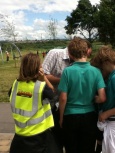
| QR codes | Editing Using QR Codes to Engage Children with Learning | |
|
Children using digital literacy to engage with reading and writing This lesson idea uses technology to promote active learning(ta) as resources were produced to be located and explored in a public park. The early stage of the activity, involving the creation of the resources by the children, required discussion(ta) involving the whole class(ta). Group talk(ta) was also employed as a strategy, with the children agreeing on a narrative(ta) outline relating to the event. The creation of the online materials encouraged development of e-skills(topic).
The later stages of activity, where the children were looking for clues, required them to ask questions(ta) and to take a collaborative(tool) approach to find a solution, based on the digital texts they found. | |
| Using images | Organising images for a narrative | |

|
Write an essay without words The lesson encourages students to think about how to portray their knowledge through narrative(ta) - which may engage some students who would usually be less interested. The lesson encourages students to think about how to capture valuable information and ensure that key elements are highlighted while not 'overloading' the viewer with data. The lesson can be tailored to any age group - for younger pupils the task could be to take before and after photos and label them. More advanced pupils might explore time-lapse photography. Pupils should be encouraged to think about how this relates to the scientific method(ta) The task is interactive and could be conducted as a group work(ta) activity or as an element of an inquiry-based learning project. It could also lend itself to whole class(ta) dialogue(ta) and the use of ICT(i) including 'clicker' response systems for assessment(ta) and questioning(ta).
| |


